If you’re searching for top CNC machine manufacturers or best CNC machine brands, you’re usually trying to solve two problems at once:
- “Which brands are globally trusted?” and
- “Which CNC machine brand is actually right for my work—metal machining, woodworking, cabinet making, or production routing?”
Most “Top 10 CNC brands” articles answer #1 and barely touch #2. This guide does both: a quick global shortlist first, then a practical framework to choose by machine type, industry, budget, software, service, and long-term cost.
Along the way, you’ll see the terms CNC manufacturers, CNC machine makers, and CNC machine brands used precisely—so you can search and compare suppliers without mixing categories.
Quick comparison: Top 10 CNC machine brands worldwide
Selection logic: These brands are widely recognized in industrial CNC (metal cutting, sheet metal, controls/automation) and woodworking production systems. They are not all in the same category—so “rank” is a convenience, not a universal quality score.
Rank | Brand | Country/Region | Best known for | Best for | Not ideal for |
|---|---|---|---|---|---|
1 | DMG MORI | Germany/Japan | 5-axis milling, turning, automation | High-end precision metal machining | Budget-focused woodworking CNC router buyers |
2 | Mazak | Japan | Multi-tasking CNC, turning, machining centers | Production metalworking | Small cabinet shops that only need a router |
3 | Haas | USA | Value-oriented CNC mills & lathes | Job shops and small manufacturers | Ultra-premium tolerance chasing |
4 | Okuma | Japan | CNC lathes & machining centers (with strong controls) | Precision manufacturing | Wood panel nesting workflows |
5 | Makino | Japan | High-speed machining, mold & die | Tooling, molds, aerospace/auto parts | Entry-level CNC purchasing |
6 | TRUMPF | Germany | Laser cutting & sheet metal systems | Sheet metal cutting/fabrication | Woodworking CNC router applications |
7 | FANUC | Japan | CNC controls, robotics, automation ecosystem | Machine builders and automated cells | Buyers who want a single-brand “all-in-one” router line |
8 | Biesse | Italy | Woodworking CNC and panel processing | Furniture/cabinet factories | Metal milling & turning |
9 | HOMAG | Germany | Panel furniture production systems | Large-scale cabinet & panel lines | Small workshops with limited floor space |
10 | SCM Group | Italy | Woodworking machinery and CNC routers | Furniture and woodworking shops | Pure metal CNC lathe/mill needs |
Before you shortlist brands: don’t compare CNC mills, lathes, lasers, and routers like they’re the same
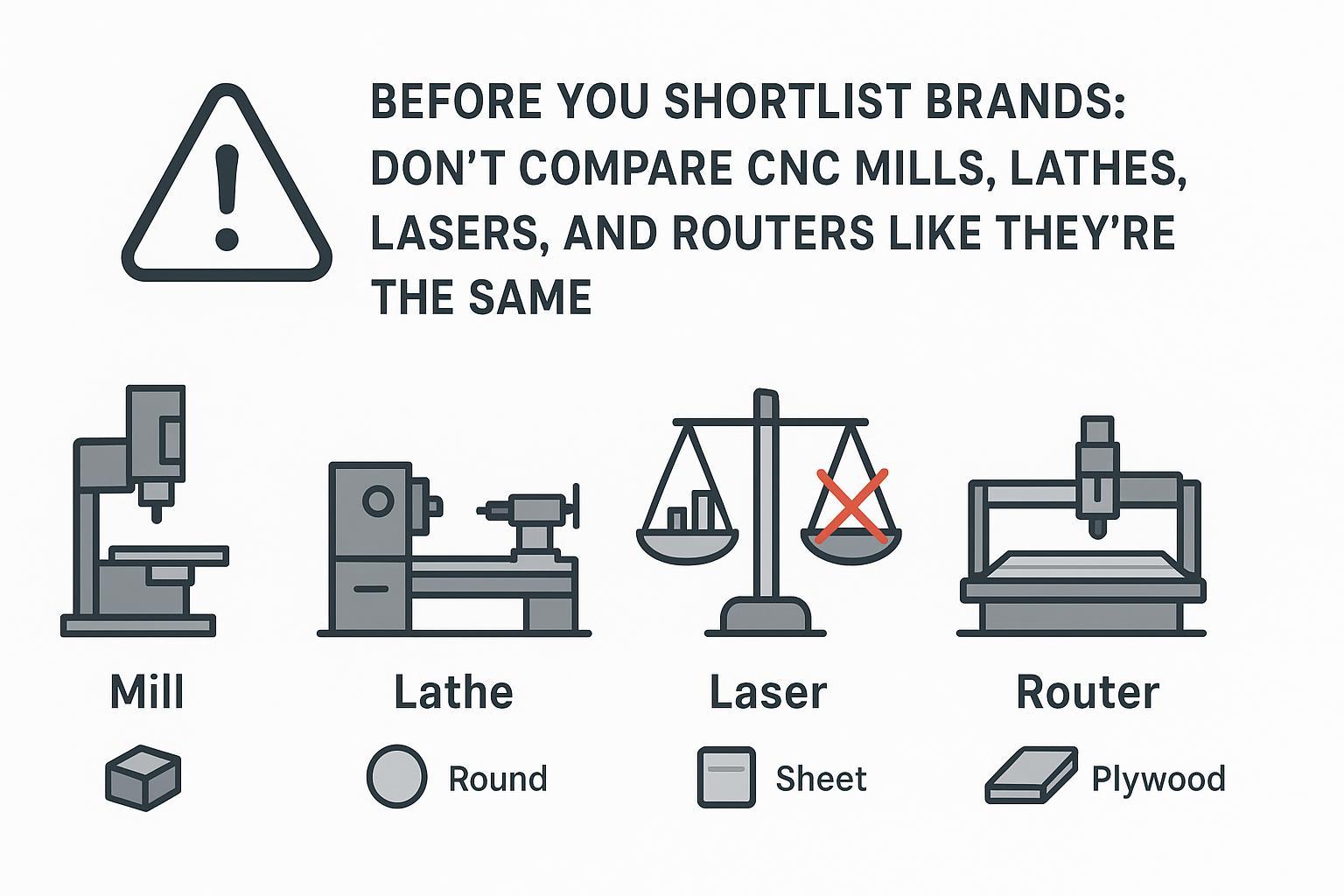
A big reason CNC brand research gets confusing is that “CNC machine” can mean very different machines:
- CNC machining centers / CNC mills (metal cutting, high rigidity)
- CNC lathes (turning shafts, cylinders, round parts)
- Laser cutting / sheet metal systems (TRUMPF/AMADA-type workflows)
- Woodworking CNC routers (nesting sheet goods, cabinet parts, doors, sign-making)
- CNC controls & automation (FANUC, Siemens, robotics, digital twin)
Even if two machines both “cut material,” their structure, spindle/torque, and intended materials can be wildly different.
For example, a CNC router is commonly used for wood, plastics, composites, and sheet work, while CNC mills are typically built with more rigidity for harder metals and higher-precision machining. For a practical comparison, see Xometry’s CNC router vs. CNC mill guide and DATRON’s breakdown of rigidity and use-case differences.
Top CNC machine manufacturers: what each brand is best for (and what it’s not)
Below is the shortlist again, but in the format buyers actually need: strengths, best-fit users, and “don’t buy this for the wrong job.”
1) DMG MORI
- Main machine types: CNC milling / machining centers, 5-axis, turning, automation cells
- Core strengths: premium build, high-end precision, advanced automation options
- Best for: aerospace, automotive, medical, precision metal parts, complex 5-axis work
- Not best for: cabinet shops and woodworking businesses buying their first production router
- Buying note: If your work is mostly sheet goods (MDF/plywood/particle board), focus first on nesting, tooling changeover, dust collection, and software compatibility—those are rarely the reasons someone chooses a high-end metal-cutting OEM.
2) Mazak
- Main machine types: machining centers, CNC lathes, multi-tasking (mill-turn)
- Core strengths: production metalworking, multi-tasking platforms, strong global reputation
- Best for: high-utilization metal production environments
- Not best for: simple cabinet cutting where a woodworking CNC router is the right category
- Buying note: Mazak is often a “metal production” shortlist brand. If you’re buying for cabinetry or panel furniture, you’re shopping a different ecosystem.
3) Haas
- Main machine types: CNC mills and lathes
- Core strengths: value-for-money, availability, strong adoption in job shops and education
- Best for: job shops, small manufacturers, budget-conscious metal machining
- Not best for: factories that need a full woodworking panel workflow (nesting + drilling + labeling + loading)
- Buying note: Haas is frequently a smart “first serious CNC mill” choice. But don’t assume a good CNC mill brand automatically implies a good CNC router lineup.
4) Okuma
- Main machine types: CNC lathes, machining centers, integrated controls
- Core strengths: stability, precision, and control integration
- Best for: turning and milling in demanding metal environments
- Not best for: woodworking nesting/router workflows
- Buying note: If your keyword is “manufacturers of CNC lathe,” Okuma typically belongs on that shortlist.
5) Makino
- Main machine types: high-speed machining centers, EDM (in some product families)
- Core strengths: high-speed machining, mold & die performance
- Best for: mold making, tight-tolerance metal cutting, high surface-finish requirements
- Not best for: price-sensitive buyers or those doing mostly wood sheet processing
- Buying note: Excellent when surface finish and speed in metal are the business. Less relevant if your bottleneck is panel throughput and drilling patterns.
6) TRUMPF
- Main machine types: laser cutting, sheet metal fabrication systems
- Core strengths: sheet metal processing ecosystems
- Best for: metal sheet cutting, bending-related workflows, fabrication shops
- Not best for: woodworking CNC router buyers
- Buying note: TRUMPF answers “CNC” for sheet metal—not for cabinet nesting or panel furniture.
7) FANUC
- Main machine types: CNC control systems, robotics, factory automation
- Core strengths: controls + automation ecosystem (many machine builders integrate FANUC)
- Best for: machine builders, factories building automated cells, robotics-driven productivity
- Not best for: readers who think FANUC is a “complete CNC machine brand list” for routers
- Buying note: FANUC is widely known for factory automation; its official site is FANUC America. If you want a comparable CNC-control vendor, Siemens’ SINUMERIK CNC systems are also a major control platform.
8) Biesse
- Main machine types: woodworking CNC machining centers, panel processing
- Core strengths: woodworking production systems and factory-grade solutions
- Best for: furniture and cabinet factories standardizing panel processing
- Not best for: metal lathe/mill buyers
- Buying note: If your business is woodworking, Biesse belongs in the conversation. The next step is selecting the right router type (nesting vs PTP vs 5-axis), not just choosing a brand name.
9) HOMAG
- Main machine types: panel furniture production systems (often broader than “just routers”)
- Core strengths: integrated systems thinking for large woodworking production
- Best for: large cabinet and panel lines that care about throughput and standardization
- Not best for: smaller shops with limited floor space and limited commissioning bandwidth
- Buying note: HOMAG can be a great fit when you’re building a line—not when you just need a single router to get orders out.
10) SCM Group
- Main machine types: woodworking machinery and CNC routers
- Core strengths: broad woodworking equipment portfolio
- Best for: woodworking and furniture production
- Not best for: pure metal milling/turning needs
- Buying note: SCM is one of the names that shows why “CNC machine brands” must be segmented by material and process.
CNC machine brands by machine type (so you can shortlist faster)
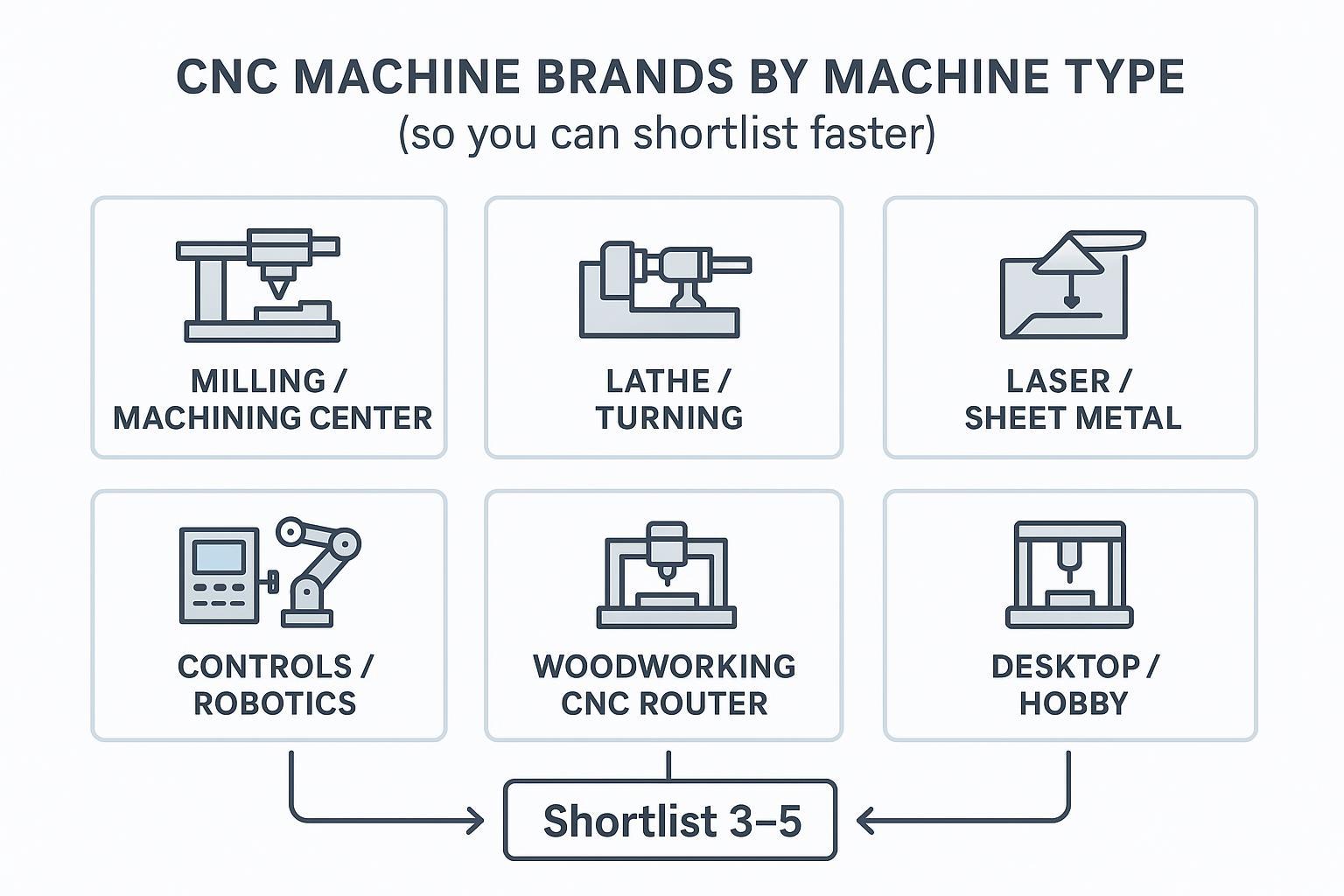
Use this table to avoid the most common mistake: choosing “the best CNC brand” from the wrong category.
Category | Brands commonly associated | Typical buyer intent |
|---|---|---|
CNC milling / machining centers | DMG MORI, Mazak, Makino, Okuma, Haas | High-precision metal machining, 3–5 axis cutting |
CNC lathe / turning centers | Mazak, Okuma, DMG MORI, Haas (plus many specialists) | Turning shafts/round parts, production turning |
CNC laser / sheet metal | TRUMPF (and other sheet metal OEMs) | Sheet metal cutting/fabrication systems |
CNC controls / robotics | FANUC, Siemens, Heidenhain | Automation, control platform selection, machine integration |
Woodworking CNC routers | HOMAG, Biesse, SCM (plus many regional router makers) | Cabinet making, panel furniture, doors, sign making |
Desktop / hobby CNC | Smaller desktop-focused brands | Makers, prototypes, light duty cutting/engraving |
Which CNC brand type fits your business? (industry-by-industry guidance)
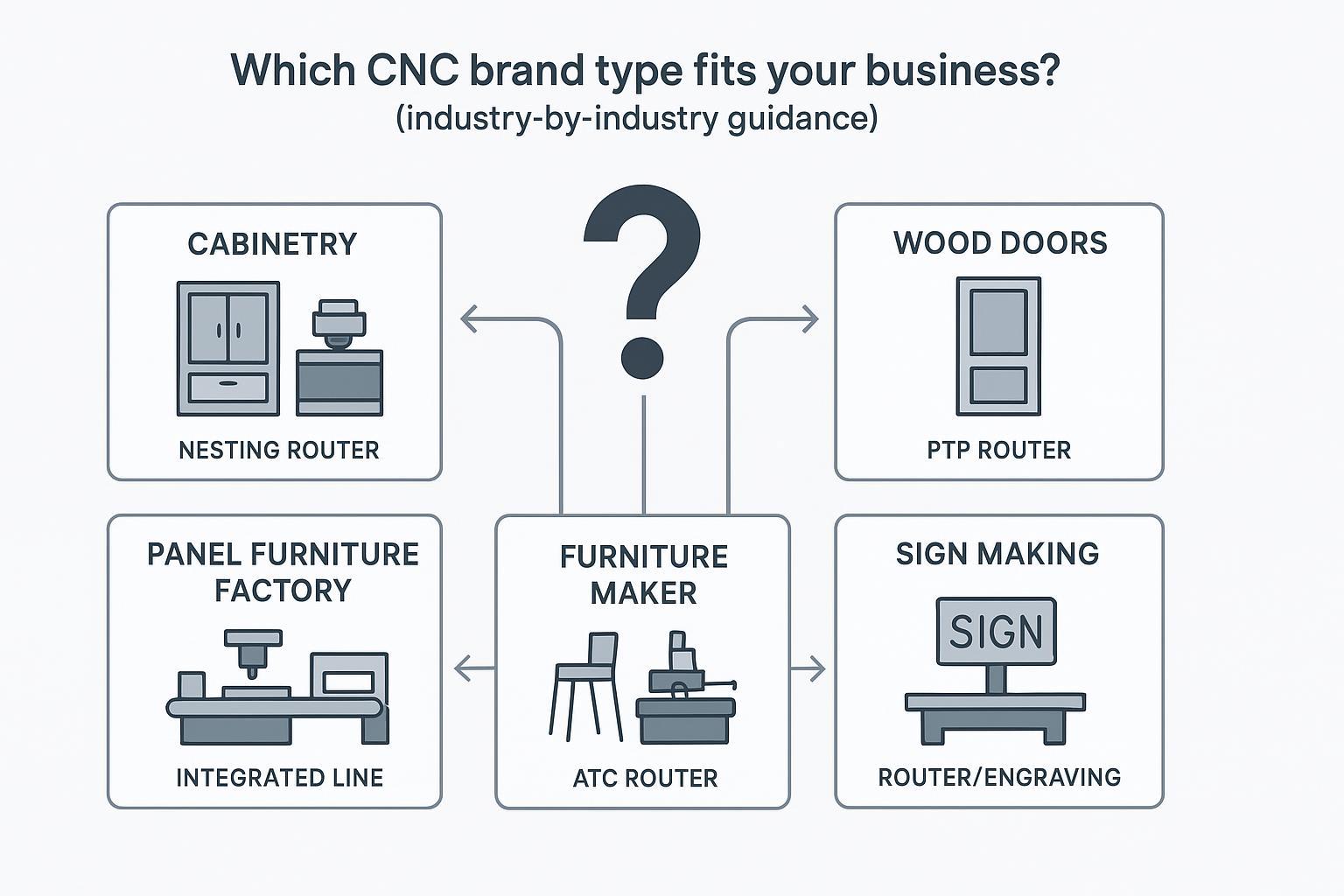
This is the part most “Top 10 CNC brand” posts miss: your industry determines your machine category, and your machine category determines which manufacturers matter.
Cabinet makers & custom cabinetry
What you should care about first:
- Nesting CNC router workflow (sheet optimization, part labeling, consistent cutting)
- ATC (automatic tool changer) if you do frequent tool changes for pockets/drilling/engraving
- Drill bank / boring head if side holes and multi-hole patterns are a daily bottleneck
- Vacuum hold-down stability, dust extraction, and repeatable positioning
- CAM/post-processor and your design-to-production workflow
Best-fit brand categories: woodworking CNC router manufacturers + panel processing specialists.
If you’re comparing machines (not just brands), browsing a router-focused lineup can help you map what configurations exist. Start from a product overview like Quick CNC’s machines catalog and then filter by your workflow (nesting vs PTP vs 5-axis).
Panel furniture factories (high-mix sheet goods)
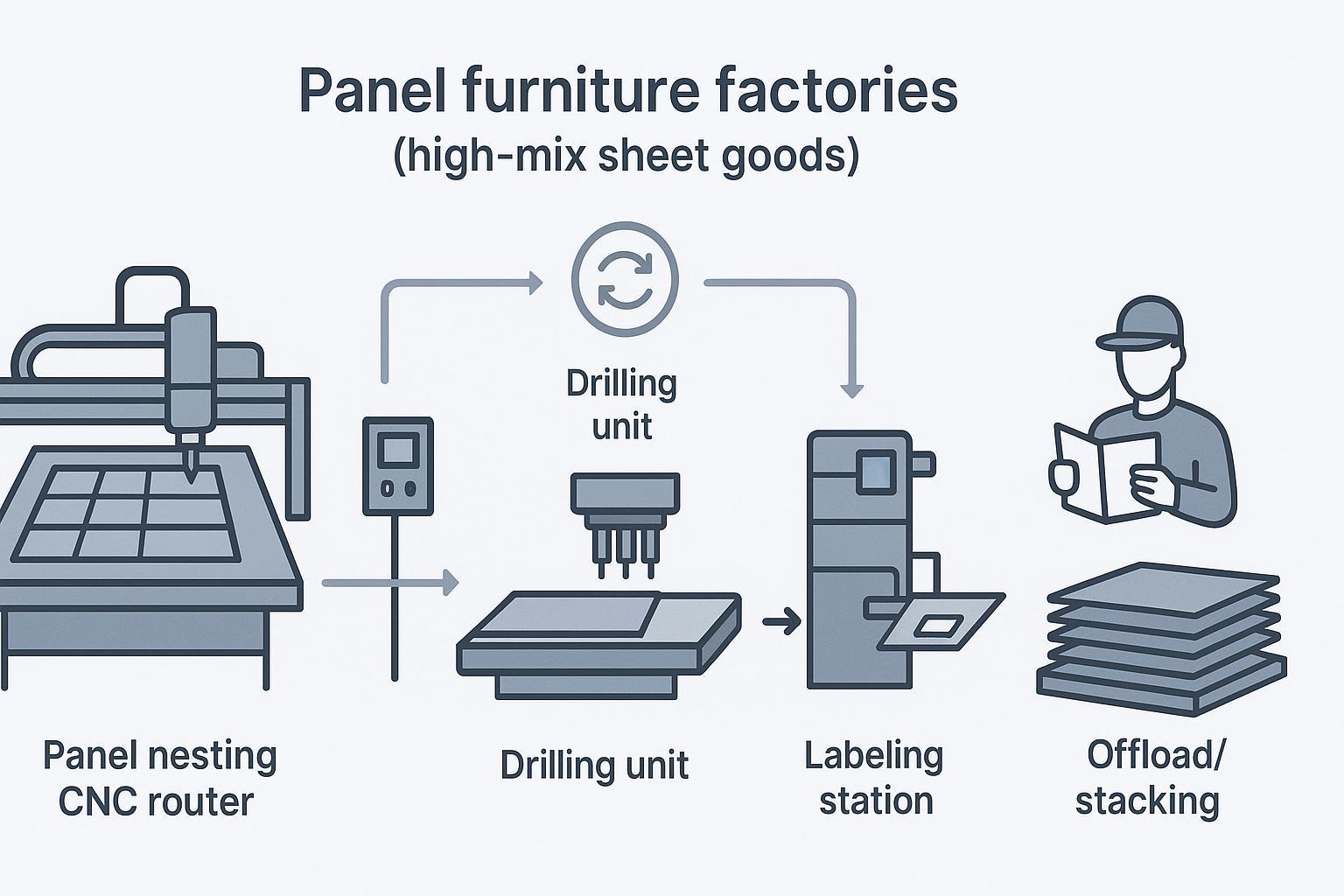
What you should care about:
- Throughput: cutting + drilling + labeling + offload as a system
- Bottleneck balancing (ATC, drilling, unloading)
- Operator training and fast changeover
- Layout constraints and dust collection integration
Best-fit brand categories: integrated woodworking production systems (HOMAG/Biesse/SCM-type) or a router manufacturer that can scale from standalone to line-level solutions.
Wood door manufacturers
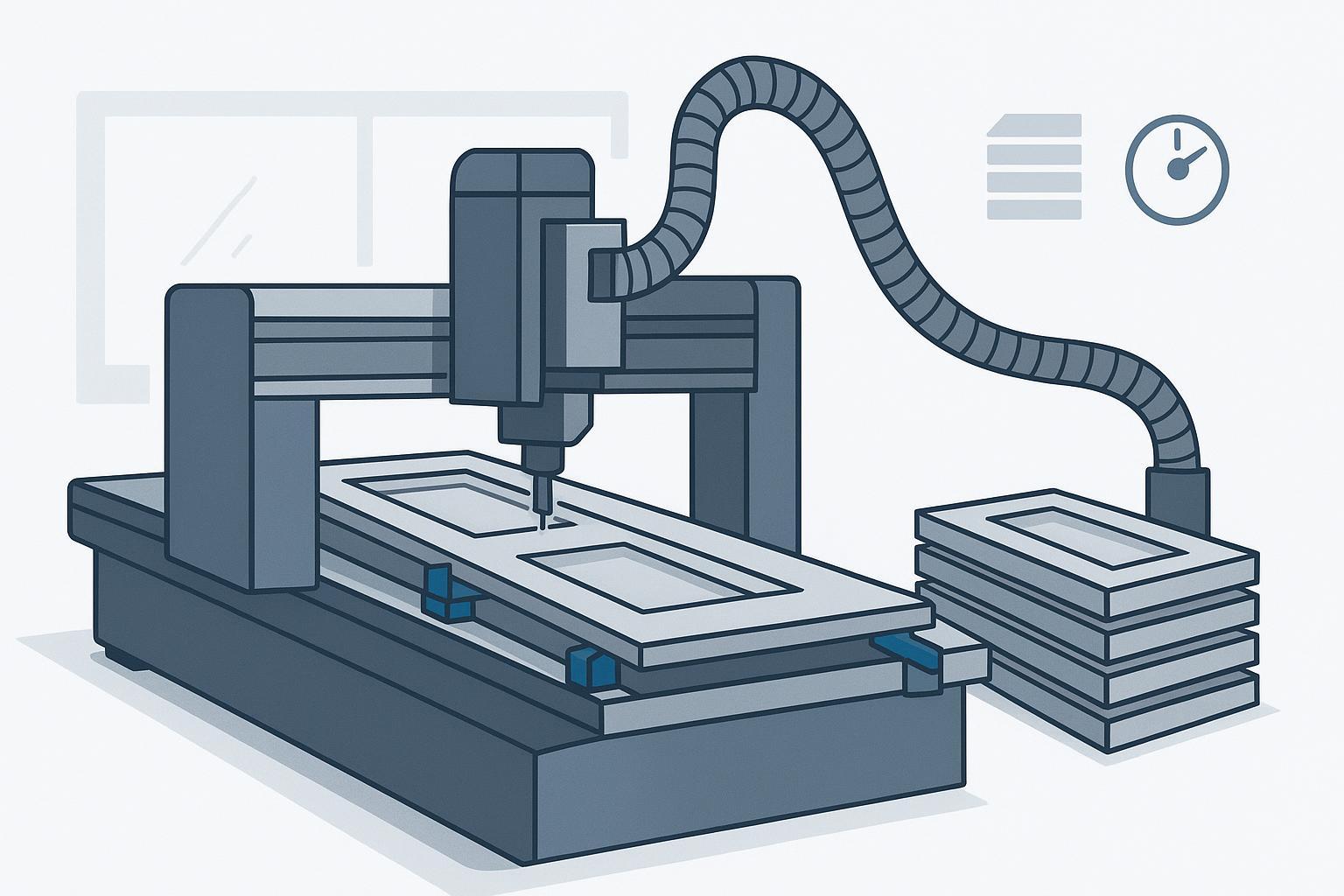
What you should care about:
- Door panel carving, pockets, lock holes, hinge slots
- Heavy gantry rigidity and stable fixturing
- Repeatability across long runs
Best-fit machine types: PTP routers and robust ATC routers. For example, a dedicated door/panel workflow often fits a PTP CNC router format like Quick CNC’s PTP CNC router.
Furniture makers (solid wood + panels)
What you should care about:
- ATC for mixed operations
- 4-axis if you do rotary carving or cylindrical parts
- Tooling and dust management (because downtime is expensive)
Best-fit approach: shortlist router makers by parts you actually cut (table legs? chair backs? panels?), then evaluate rigidity + spindle + tooling + support.
Sign makers / advertising shops (acrylic, PVC, MDF)
What you should care about:
- Clean edge quality on acrylic/PVC
- Repeatable cutting and engraving
- Practical workholding and dust/chip management
Best-fit category: woodworking/production CNC routers (not metal machining centers).
Mold making in wood/foam (complex 3D surfaces)
If you’re cutting foam, wood molds, or complex surfaces, 5-axis capability can become relevant.
A practical starting point is understanding what a 5-axis woodworking router looks like in production, such as Quick CNC’s 5-axis wood CNC router.
Distributors and dealers
What you should care about:
- Product line completeness (entry → mid → production)
- Lead time stability and spare parts availability
- Documentation and training materials
- Remote support capability
A dealer doesn’t win by having the “most famous” brand; they win by supporting the machines profitably and reliably.
Best value woodworking CNC router brands (including Chinese CNC router manufacturers)
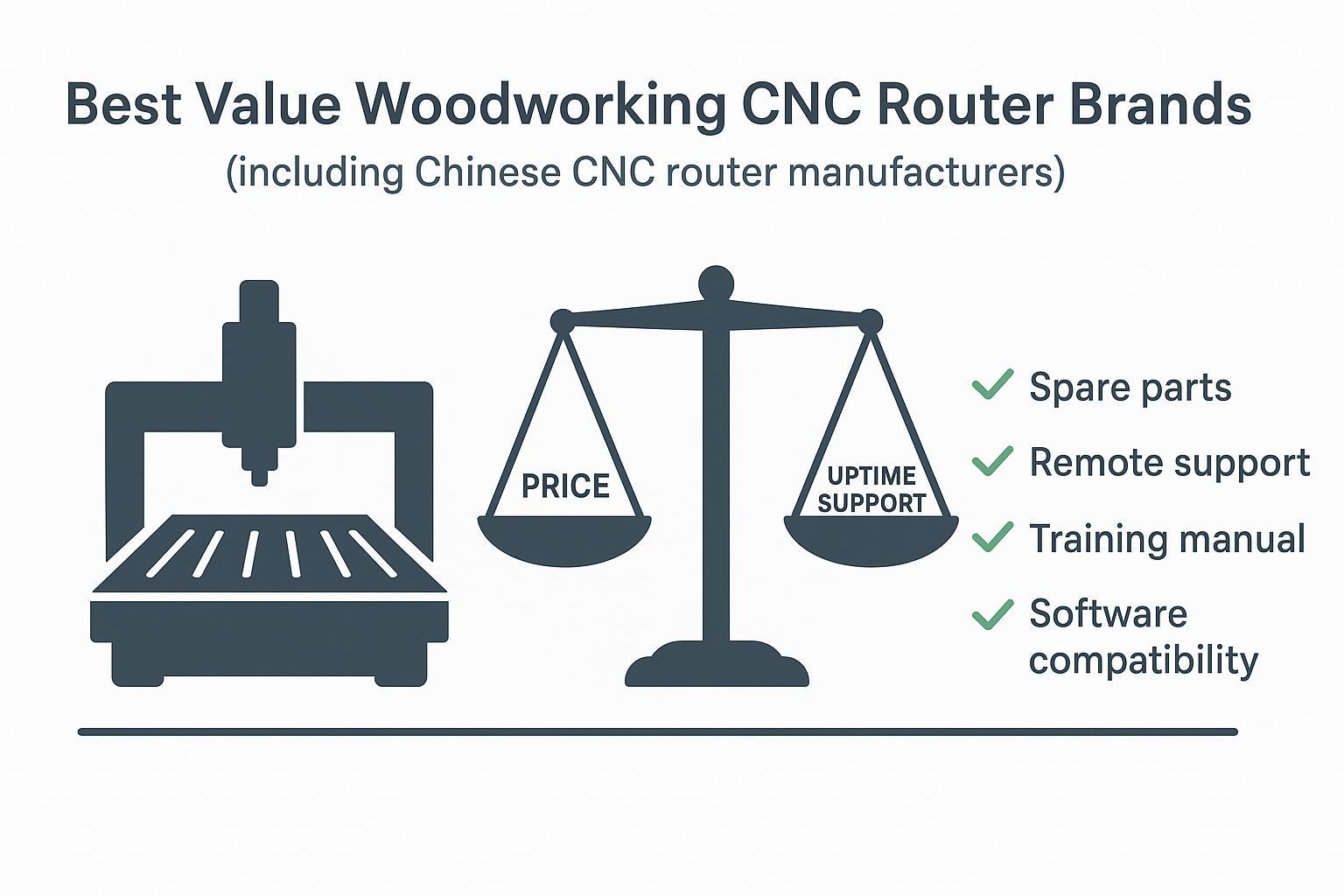
If your application is woodworking, cabinet making, or sign-making, it’s reasonable to evaluate a different set of brands than the metal-cutting giants.
Below are commonly cited Chinese CNC router manufacturers/brands that buyers often compare in the woodworking router category (positioned by fit, not hype). Think of these as value-tier CNC manufacturers you evaluate with extra focus on support and parts:
Brand | Generally known for | Best fit for |
|---|---|---|
Blue Elephant CNC | Router-focused lineup including ATC and nesting-oriented machines | Cabinet/furniture shops wanting production routers |
StyleCNC | Broad CNC catalog; many router models and configurations | Buyers needing many options across budgets |
BCAMCNC | Router lineup spanning entry to more advanced systems | Shops scaling from starter to production |
TechPro CNC | Routers plus panel furniture/line equipment in the product range | Factories planning broader woodworking workflows |
ULI-CNC | Woodworking-focused equipment categories | Woodworking and furniture production buyers |
Pro Tip: With value-tier suppliers, the “brand” is only half the risk. The other half is service, spare parts, training, and software compatibility. Those determine your real uptime.
CNC machine manufacturer vs CNC machine brand vs CNC machine maker
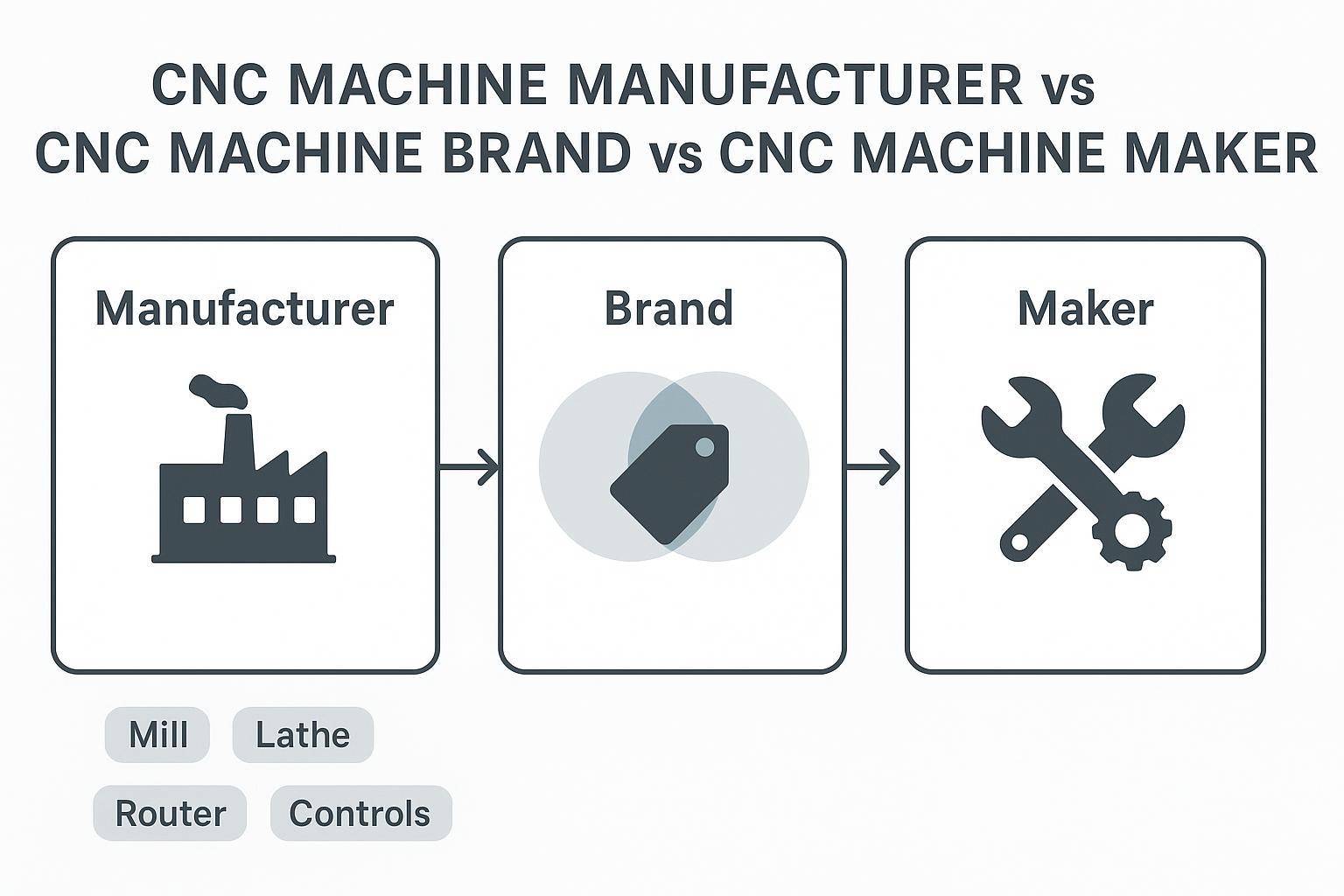
These terms are often used interchangeably in search, but buyers can mean different things:
Term | What the user usually means |
|---|---|
CNC machine manufacturer | A company that actually builds CNC machines (routers, mills, lathes, etc.) |
CNC machine brand | A market-facing name; may manufacture, or may be a product line within a group |
CNC machine maker | Often synonymous with manufacturer (machine builder) |
CNC milling machine brands | Brands known for machining centers / metal cutting |
Manufacturers of CNC lathe | Brands known for turning centers |
CNC router brands | Brands known for woodworking and sheet processing routers |
CNC control brand | Control/automation suppliers (e.g., FANUC, Siemens) rather than complete machine OEMs |
How to choose the right CNC machine brand (a practical checklist)
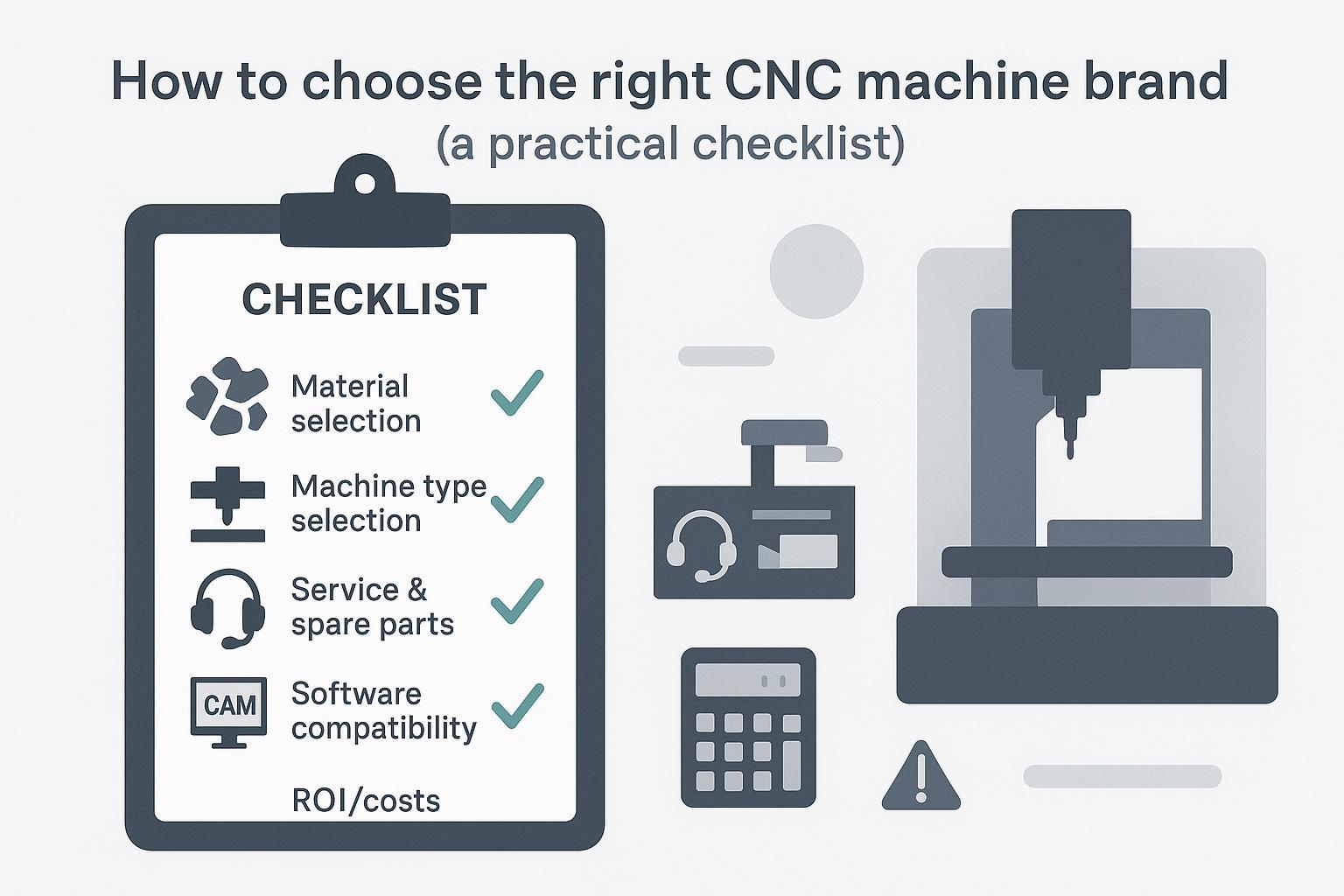
Here’s the decision framework that reduces expensive trial-and-error.
1) Start with your material and your process
- Mostly hard metals and tight tolerances → machining center / CNC mill brands
- Mostly round parts → CNC lathe manufacturers
- Mostly sheet goods (MDF/plywood/particle board), plastics, acrylic → woodworking CNC router brands
If you’re unsure whether your workflow is “router” or “mill,” compare the intended use cases using references like Xometry’s router vs. mill guide (materials and typical applications).
2) Choose the machine type before you choose the logo
For woodworking buyers, the key question is rarely “which global giant is #1?”
It’s:
- Do you need a nesting CNC router?
- Do you need ATC (automatic tool change)?
- Do you need a drill bank for cabinet holes?
- Do you need loading/unloading automation?
A lineup that makes these options easy to compare is a better starting point than a generic brand list. For example, you can browse configurations in Quick CNC’s machine catalog and then short-list comparable vendors.
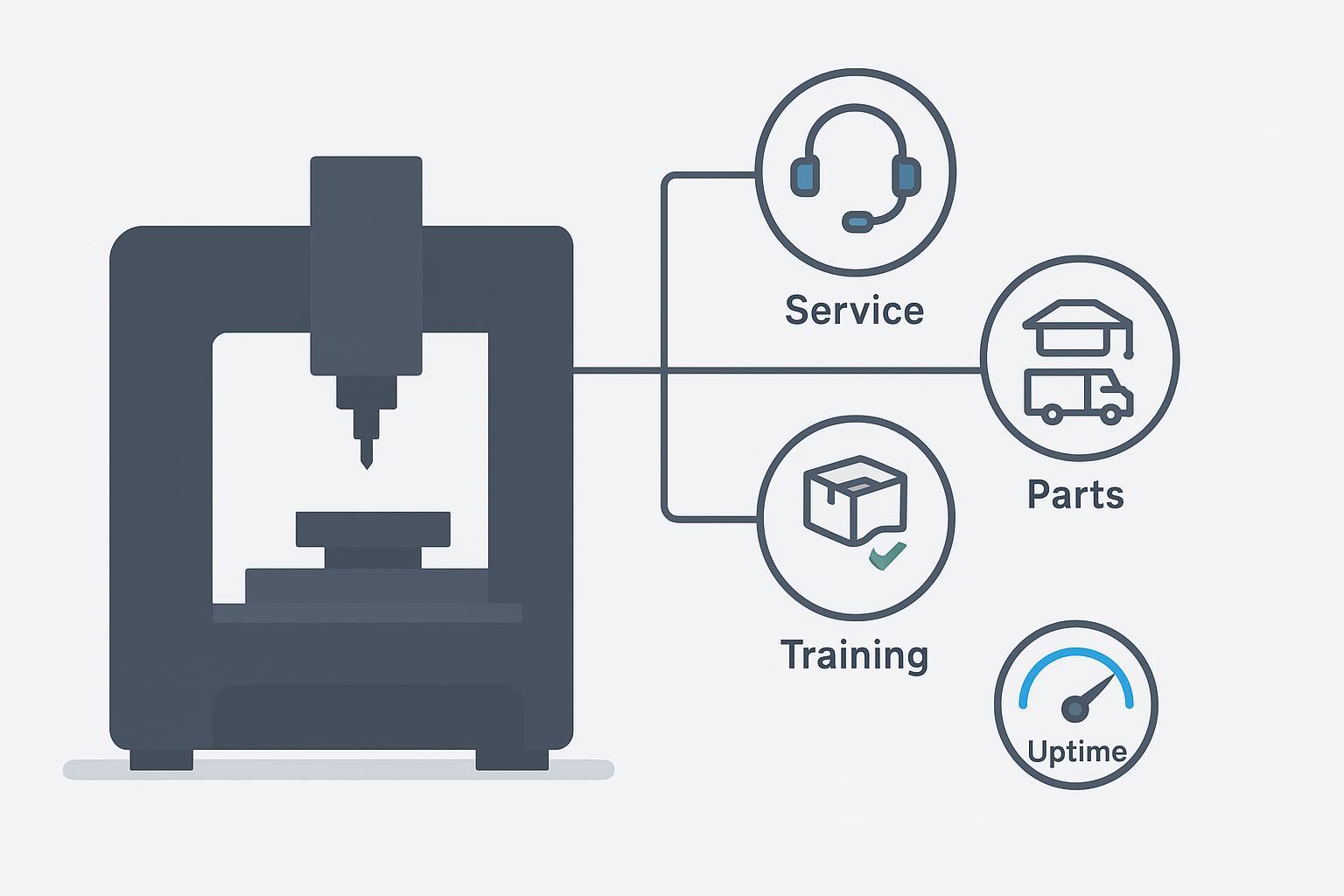
3) Treat service, spare parts, and training as “core specs”
Many buyers focus on spindle power and axis count—then lose weeks on issues that were predictable:
- Is local service available (or at least fast remote support)?
- How long do common spare parts take to arrive?
- Is training included (operator + maintenance)?
- Is documentation good enough for new operators?
If you want a deeper look at controls and service ecosystems, start with the official pages for FANUC and Siemens (SINUMERIK) and then compare how local integrators and machine builders support those ecosystems in your region.
⚠️ Warning: Downtime is usually the most expensive line item in CNC ownership—because it hits delivery dates, labor utilization, and customer trust all at once.
4) Make software compatibility explicit (don’t assume)
Ask up front:
- What CAM software do you use now?
- Do you need post-processors?
- Who supports post edits when you change tooling or add an axis?
5) Build a simple ROI view (without fake precision)
You don’t need a perfect model. You need a realistic one.
- Output target: parts/day or sheets/day
- Labor constraint: operators available, skill level
- Changeover frequency: high-mix vs long runs
- Scrap/rework impact: edge quality, hole position, assembly fit
If a machine helps you reduce changeover and stabilize quality, that is often a better “ROI lever” than chasing the highest spec on paper.
Hidden costs to consider (the list that protects your budget)
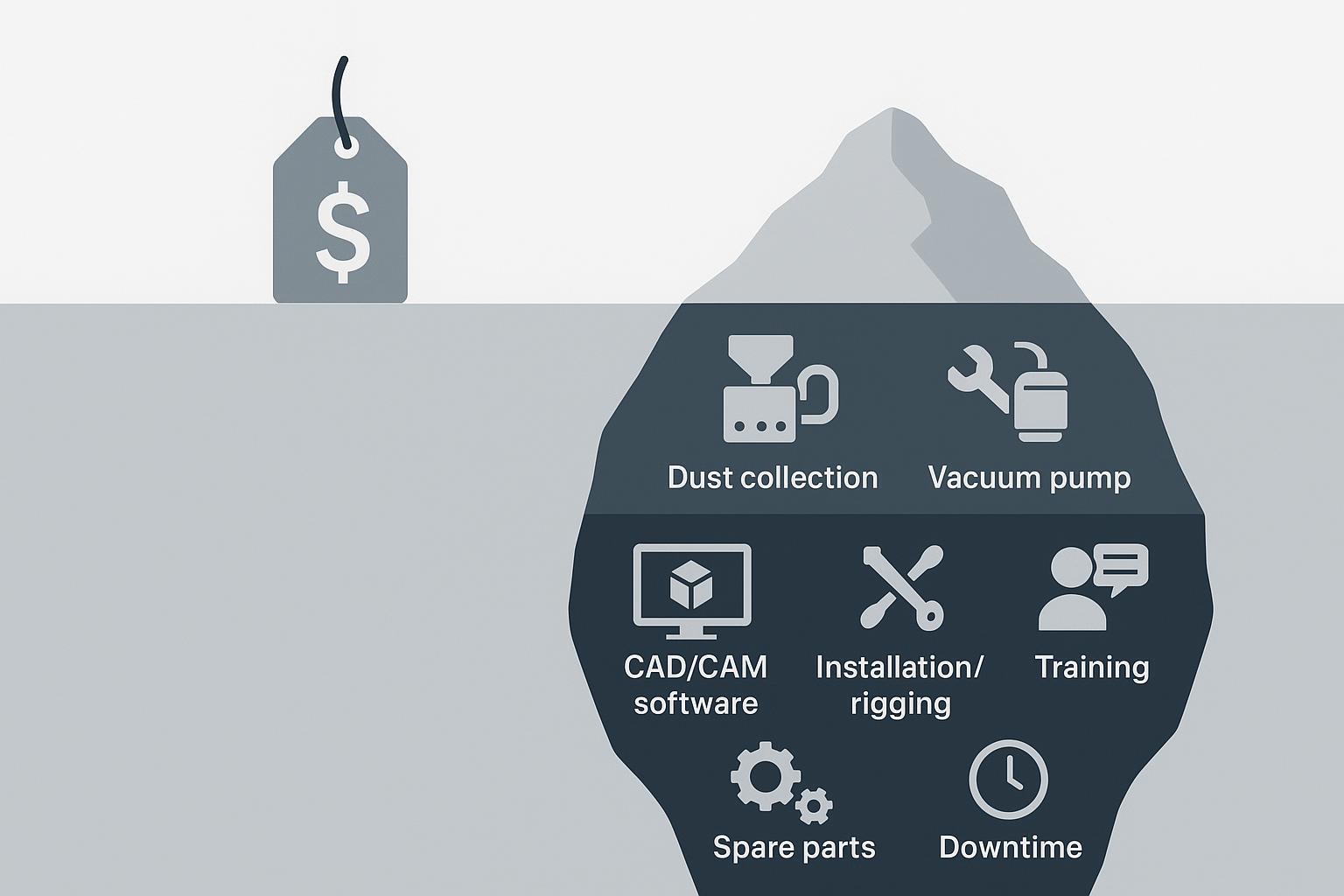
When buyers search best CNC machine company, they often underestimate everything around the machine.
Here’s the practical checklist:
- Dust collection system (and ducting)
- Vacuum pump capacity, zoning, and vacuum table consumables
- Tooling: cutters, collets, tool holders (especially for ATC)
- Drill bits and boring head maintenance
- Spoilboard surfacing and replacement
- CAD/CAM software + subscriptions
- Post processor development/maintenance
- Installation, rigging, and commissioning
- Operator training time
- Spare parts and preventive maintenance
- Downtime planning (what happens if the spindle or vacuum system stops?)
Myth vs Fact: common CNC brand misconceptions
Myth 1: “The #1 global CNC brand is the best choice for every factory.”
Fact: CNC brands are optimized for different materials and workflows. A world-class metal machining OEM can be the wrong fit for a cabinet shop.
Myth 2: “CNC controls brands are the same as machine brands.”
Fact: Control suppliers like FANUC and Siemens SINUMERIK are often the control/automation layer used by many different machine builders.
Myth 3: “If the spec sheet looks great, the machine will be easy to run.”
Fact: Commissioning speed depends on training, documentation, post processors, and service responsiveness—not just specs.
CNC manufacturing news today: trends worth watching (without the hype)
This section is short on purpose. The point isn’t to chase headlines—it’s to understand where CNC ownership is going.
- Digital twins and simulation: using a virtual model to validate processes before tying up the real machine. NIST has described approaches in Building a digital twin of a CNC machine tool.
- Automation and connected production: robotics, machine tending, and connected CNC systems. FANUC, for example, describes this direction with tools like Smart Digital Twin for Manufacturing.
- Predictive maintenance and remote service: downtime prevention is becoming part of the buying decision, especially for high-utilization factories.
- Nesting optimization: better sheet utilization and shorter setup cycles are a competitive advantage for cabinet and panel furniture factories.
Woodworking CNC routers: what to look for (with a real machine example)
If you’re in woodworking, cabinet making, or panel furniture, a CNC router is usually the core production tool—not a metal machining center.
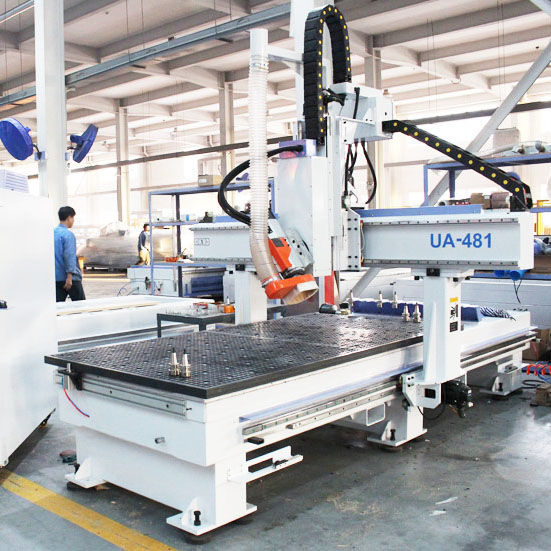
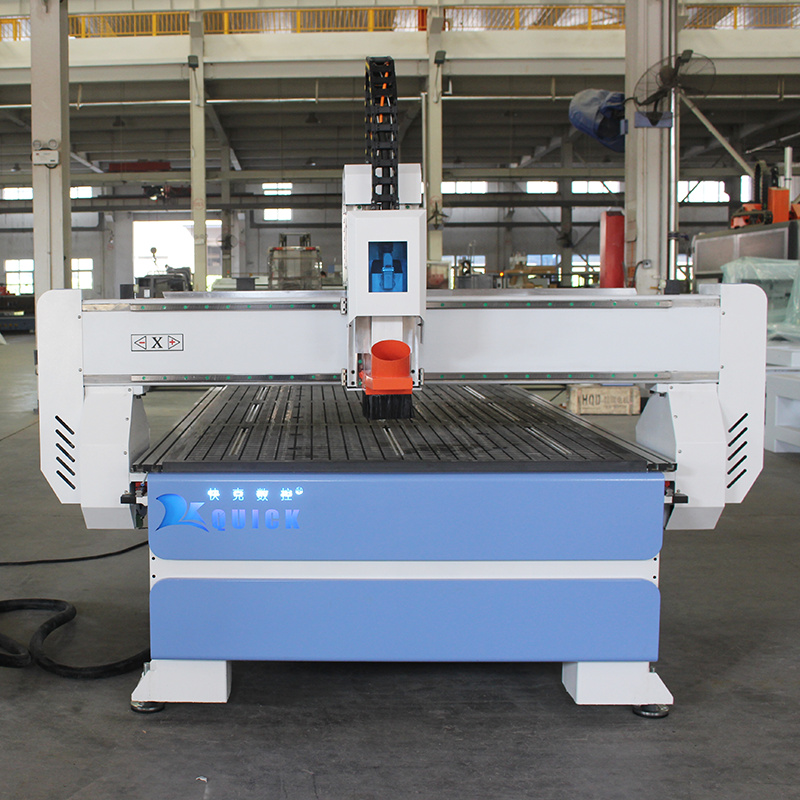
Here’s a short, concrete example of what an ATC production router looks like in practice:
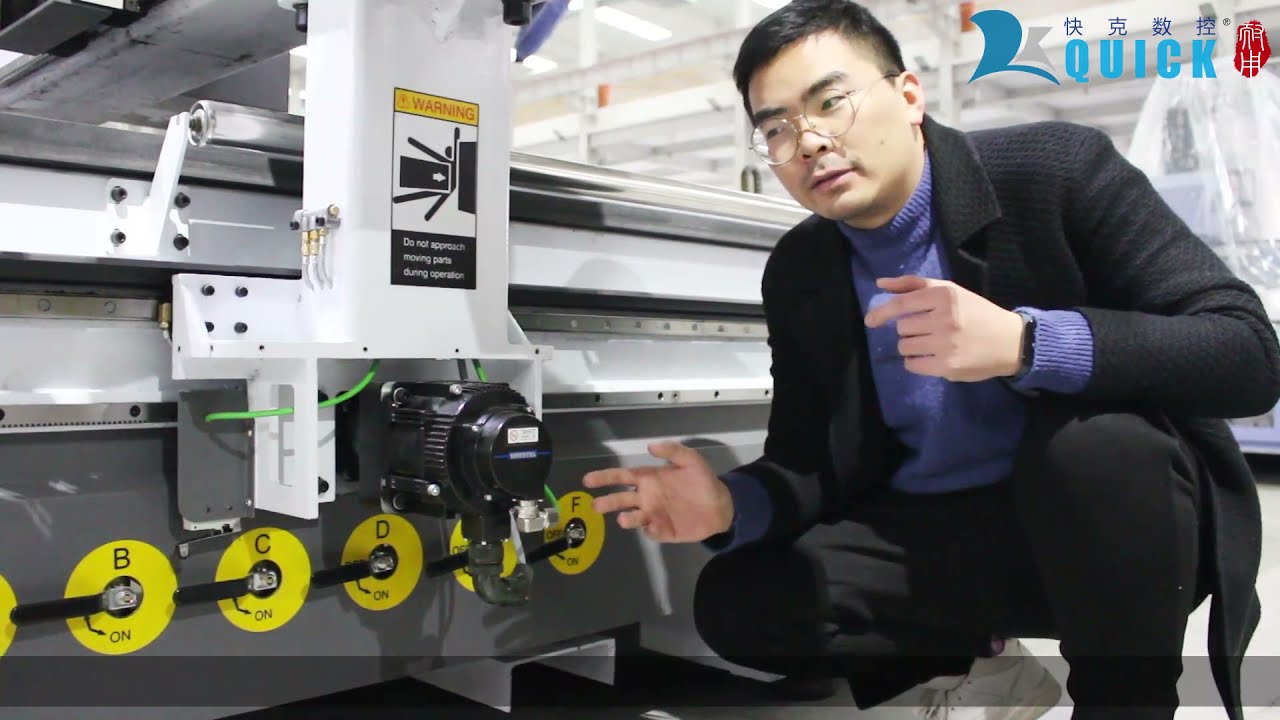
If you want a quick way to compare router configurations:
- An ATC-focused router example: UA-481 Woodworking ATC CNC Router
- A linear tool changer option: 12 Tool Linear ATC CNC Router UE-481
- A production line example (drilling + cutting workflow): CNC Drilling and Cutting Furniture Production Line RC1
Next steps (shortlist smarter, then get a configuration recommendation)
If you’re still deciding between CNC machine brands, try this sequence:
- Confirm your category (mill / lathe / laser / router).
- Shortlist 3–5 brands inside that category.
- Choose based on service + software + real workflow fit—not brand rank.
If you want help selecting a woodworking router configuration for cabinet making, furniture panels, doors, or sign making, you can request a recommendation from Quick CNC based on your materials, sheet size, drawings, output targets, and automation level.
If you’re a distributor looking for a CNC router manufacturer partnership, ask about dealer cooperation and support through the same contact channel (include your target region and expected annual volume in the message).