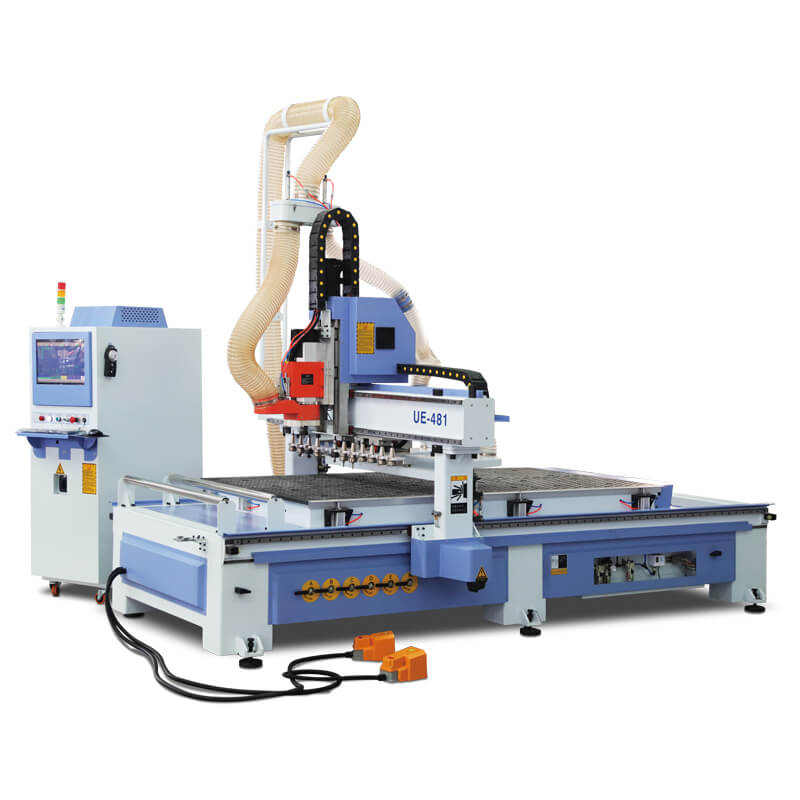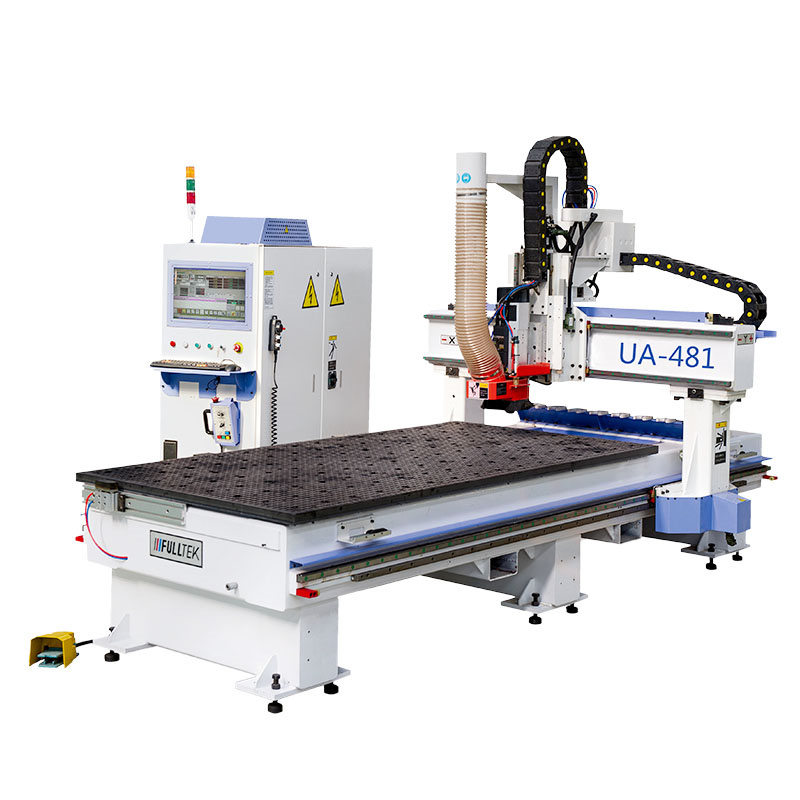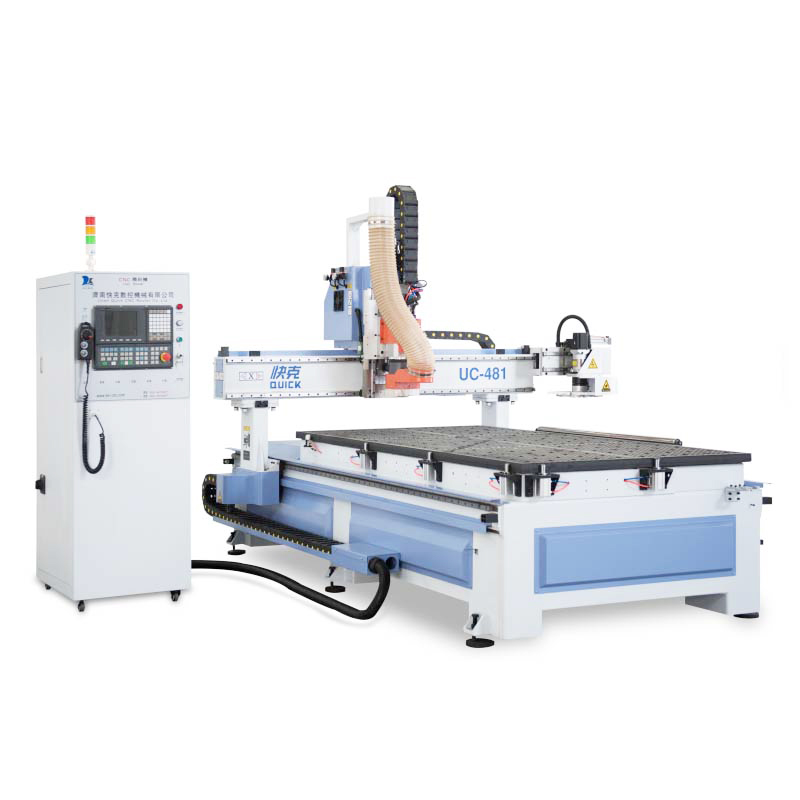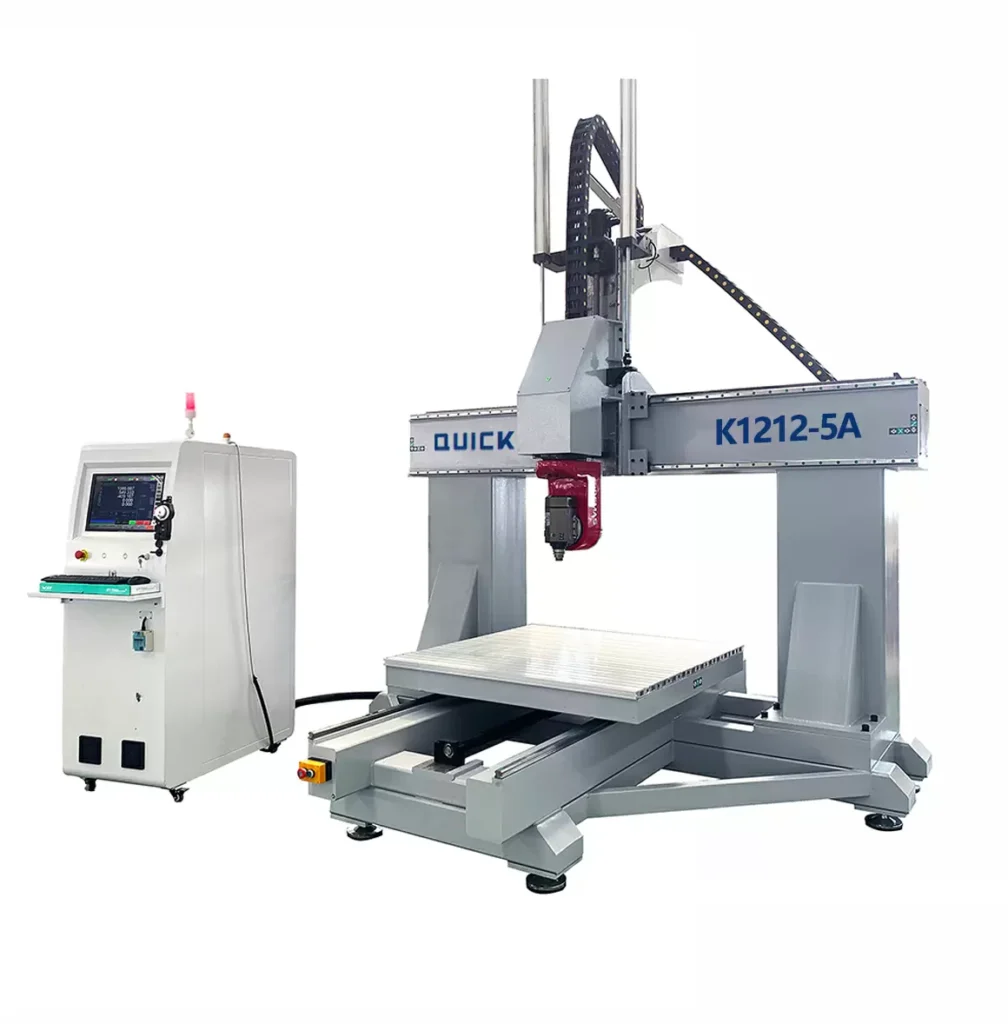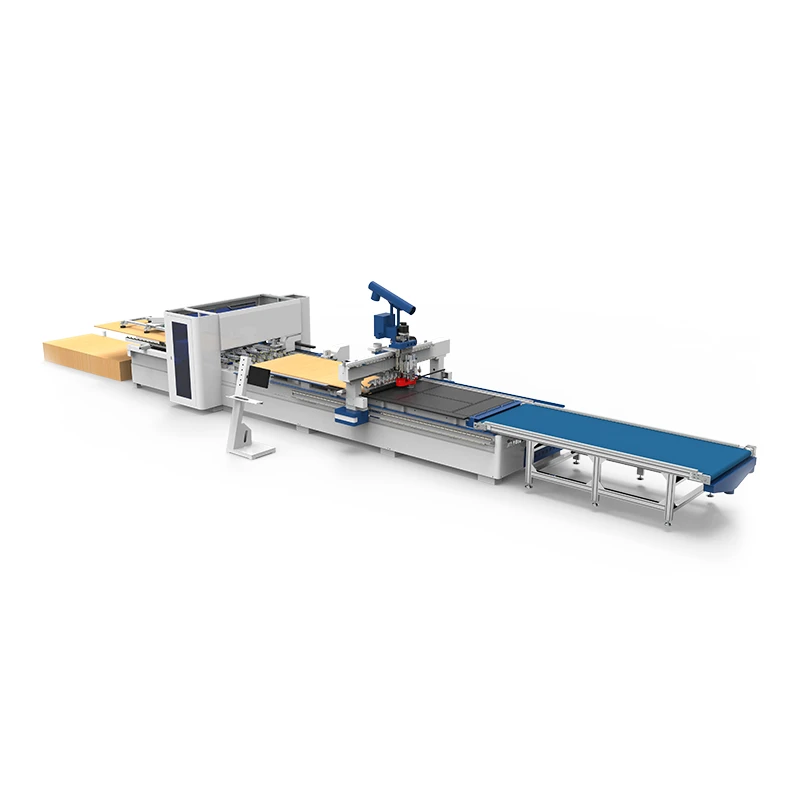
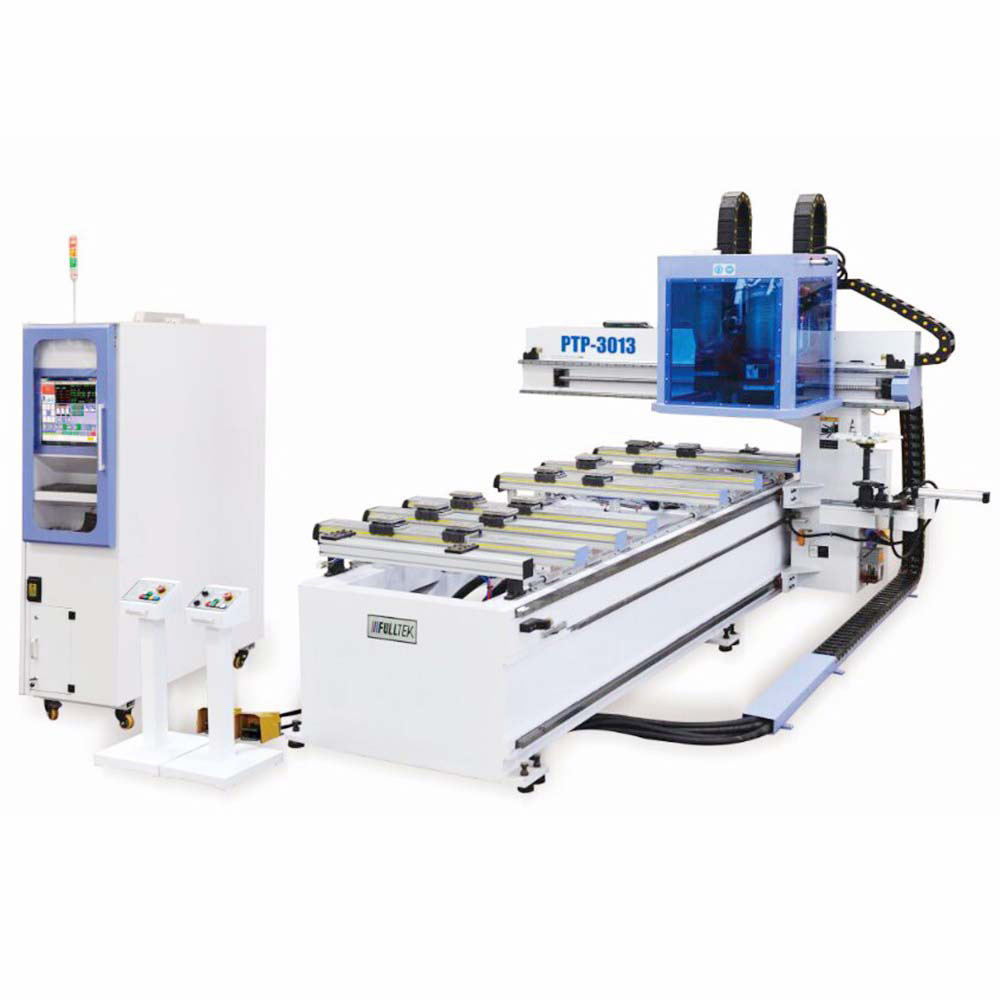
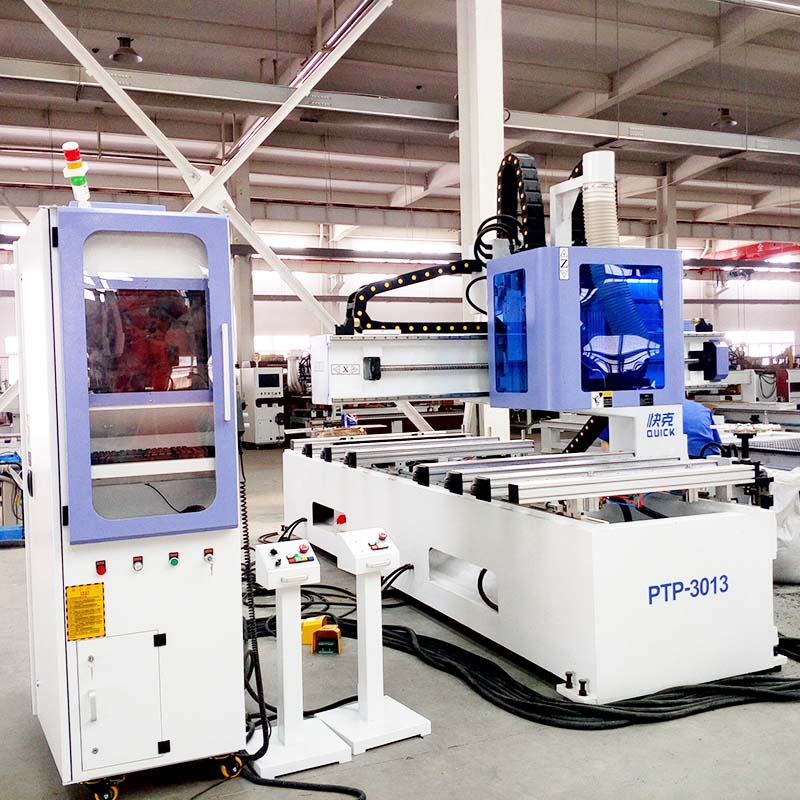
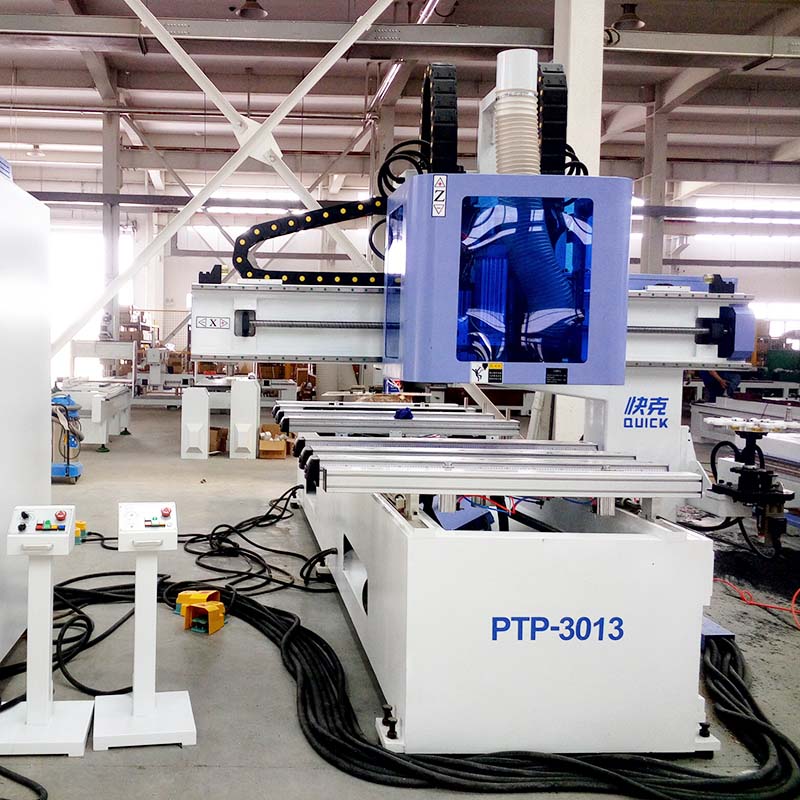
This PTP CNC router is built for woodworking shops that need more flexible workholding than a standard flat vacuum table. With Italy Schmalz rails and vacuum pods, it can hold panels, doors, and shaped furniture parts more conveniently during drilling, milling, boring, routing, and engraving.
It is especially useful for furniture parts that need multiple operations in one setup. The machine combines a 9kW HSD spindle, HSD boring head, 8-tool carousel magazine, Syntec control, and Yaskawa servo motors for professional woodworking production.
Need More Flexible Holding Than a Flat Vacuum Table?
If your workpieces are always simple flat sheets, a normal vacuum table CNC router may be enough.
But if you process doors, cabinet parts, irregular panels, or furniture components that need drilling, boring, milling, and routing, a PTP CNC router becomes more useful.
The PTP table uses vacuum pods to hold the workpiece securely. This gives you more flexibility when the part shape, machining area, or clamping position changes from job to job.
How the PTP Table Helps Your Production
A normal vacuum table is good for full-sheet cutting. But it may not be the best choice when you need access to edges, drilling positions, or the underside area around a workpiece.
A PTP table is different. It uses rails and vacuum pods to support and hold the part, leaving more open space around the panel for machining.
This is why PTP CNC routers are often used for doors, cabinets, furniture panels, and complex woodworking parts where flexible positioning matters.
Is This PTP CNC Router Right for Your Work?
Choose this machine if your daily production includes doors, cabinets, furniture panels, curved workpieces, or multi-process woodworking parts.
It is especially useful when one part needs cutting, engraving, drilling, milling, boring, or reaming in the same workflow. The reference page describes this machine as a multi-functional intelligent machining center for complex workpieces and multi-process machining.
It may not be the best choice if you only need simple full-sheet nesting. In that case, a standard nesting CNC router may be more cost-effective.
A good fit for:
- Wood door manufacturers
- Cabinet production workshops
- Custom furniture factories
- Solid wood part producers
- Shops making complex furniture components
- Workshops needing drilling and routing in one setup
- Buyers upgrading from a standard vacuum table router
How It Works in Door and Furniture Panel Processing
Door and furniture production often needs more than basic cutting. A part may need holes, hinge positions, grooves, edge work, surface engraving, and milling.
This PTP CNC router is designed to complete several processes on one machine. With the HSD spindle, HSD boring head, and carousel tool magazine, it can move between different operations with less manual intervention.
Typical workflow:
- Position the door or panel on vacuum pods
- Drill vertical or horizontal holes
- Mill grooves or slots
- Route edges or shapes
- Engrave surface details
- Change tools automatically
- Complete multi-process machining in one setup
Key Features of This PTP CNC Router
PTP pod-and-rail table
The PTP table uses Italy Schmalz rails and vacuum pods. The reference page lists 6 Schmalz rails and 18 Schmalz pods as standard equipment.
This is the core difference between this machine and a regular flat-table CNC router. It gives users more flexible support and holding for doors, panels, and shaped furniture parts.
1300 × 3000 mm working area
The working area is 1300 × 3000 × 200 mm. This size is suitable for many door panels, cabinet components, furniture parts, and longer woodworking workpieces.
For door and furniture production, the longer Y-axis travel gives more room than a standard 1325-style machine.
9kW Italy HSD spindle
The machine uses a 9kW Italy HSD spindle with a listed speed of 24,000 rpm.
This spindle is suitable for routing, cutting, milling, and engraving work. For a PTP CNC router, spindle reliability matters because the machine often handles multi-process production.
Italy HSD boring head
The machine includes an Italy HSD 12V4H boring head. This is one of the strongest reasons to choose this product over a simple CNC router.
The boring head makes the machine more suitable for furniture parts that need repeated holes, hinge holes, connector holes, and drilling operations.
Carousel 8-tool magazine
The machine uses a carousel 8-tool magazine. This helps the machine switch between machining operations without frequent operator tool changes.
For door and furniture panel production, this matters when one part needs different tools for cutting, drilling, routing, and finishing.
Syntec control system
The machine uses a Syntec control system. The reference page highlights large storage space, U-disk compatibility, fast reading speed, automatic scheduling, and anti-interference capability.
For multi-process PTP machining, stable control is important because the machine needs to coordinate tool changes, drilling, routing, and different machining files.
Yaskawa servo motors
The machine uses Japan Yaskawa servo motors. The reference page highlights high speed, high precision, instant response, and high torque.
This helps support more stable movement and better positioning during door and furniture part machining.
What You Can Process with This Machine
This PTP CNC router is designed for more than simple cutting. It is built for furniture and woodworking parts that need several machining operations.
The reference page describes automatic completion of cutting, engraving, drilling, milling, boring, reaming, and other processes.
Main processing tasks:
- Door processing
- Cabinet part machining
- Furniture panel routing
- Drilling
- Boring
- Milling
- Reaming
- Engraving
- Curved workpiece processing
- Multi-process furniture part machining
Typical Applications
Wood doors
This is one of the strongest applications for a PTP CNC router. Door production often needs hinge holes, lock holes, routing, milling, and surface processing.
The PTP table gives flexible holding, while the boring head and tool magazine help complete several operations in one workflow.
Cabinet parts
Cabinet components often need connector holes, grooves, slots, and edge processing. A PTP CNC router can help process these parts more flexibly than a simple flat-table router.
This is useful for shops making custom cabinets, wardrobes, and furniture components.
Furniture panels
Furniture panels may need drilling, milling, engraving, and shaping. The PTP table helps hold different panel sizes and shapes with vacuum pods.
This makes the machine useful for custom furniture production where every part is not exactly the same.
Curved and complex workpieces
The reference page says the machine can process curved workpieces, invisible workpieces, and multi-process complex workpieces.
That makes this machine more suitable for buyers who need flexible furniture part machining rather than only simple rectangular sheet cutting.
Signage and decorative work
The machine can also be used for signage, logos, display boards, acrylic engraving and cutting, wood crafts, gift boxes, relief sculpture, and 3D engraving.
These are useful supporting applications, but the main page focus should stay on PTP CNC router use for doors and furniture panels.
PTP CNC Router vs Standard Vacuum Table CNC Router
A standard vacuum table CNC router is good for full-sheet cutting, nesting, and large flat panels.
A PTP CNC router is different. It uses pods and rails to hold the workpiece, which gives better access around the part and more flexibility for drilling, boring, routing, and edge-related work.
If your main work is cabinet nesting, a flat vacuum table machine may be enough. If your work involves doors, panels, holes, grooves, and complex machining positions, this PTP CNC router is a better match.
Why Choose This PTP CNC Router for Your Workshop?
Choose this machine if your work requires flexible holding, drilling, boring, routing, and tool changes in one production flow.
It is not just a basic router with a different table. It combines a PTP table, HSD spindle, HSD boring head, Syntec control, Yaskawa servo motors, and carousel tool magazine.
This makes it more suitable for professional woodworking shops that need a stronger machine for doors, cabinets, and complex furniture parts.
Specifications
| Item | Specification |
|---|---|
| Model | PTP-3013 |
| Machine Type | PTP CNC Router |
| X-Y-Z Working Area | 1300 × 3000 × 200 mm |
| Repositioning Resolution | 0.02 mm |
| X-Y Movement | Rack and pinion, gear drive / Taiwan |
| Z Movement | Ball screw drive / Germany |
| Guide | Linear square / Taiwan |
| Max. Speed | 60,000 mm/min |
| Max. Cutting Speed | 30,000 mm/min |
| Spindle Power | 9kW Italy HSD |
| Spindle Speed | 24,000 rpm |
| Inverter Power | 11kW |
| Tool Magazine | Carousel 8 pcs tool changers |
| Boring Head | Italy HSD 12V4H |
| Drive Motors | Yaskawa servo motor |
| Working Voltage | AC380V / 50–60Hz, 3-phase |
| Command Code | G code |
| Computer Interface | USB 2.0 |
| Collet | ER32, 3.175 mm / 6 mm / 12.7 mm |
| Software | ALPHACAM |
| Control System | SYNTEC |
| Standard Equipment | Italy Schmalz rails 6 pcs, Italy Schmalz pods 18 pcs, positioning air cylinder 16 pcs, panel lifting blades 4 pcs, air pump, tool sensor, auto oil lubrication, dust hood |
Main Components and Advantages
Italy Schmalz PTP table
The PTP table uses high-quality vacuum pods to hold the workpiece securely. It gives users more flexible and convenient positioning for plates, panels, doors, and furniture parts.
This is the main reason to choose a PTP CNC router instead of a normal flat table router.
HSD spindle and boring head
The spindle and boring head are from HSD. The reference page describes HSD as a global leader in the mechatronics sector.
For buyers, this matters because spindle and boring head quality directly affect routing, drilling, boring, and milling performance.
Syntec-PC control system
The Syntec-PC system supports large storage, U-disk compatibility, fast reading, automatic scheduling, and reliable file processing.
This is important for workshops that need to process many different furniture parts and programs.
Japan Yaskawa servo motor
Yaskawa servo motors help support high speed, high precision, and fast response. The reference page also says the motor torque can reach 350%, helping shorten acceleration and deceleration time.
For PTP machining, stable movement and accurate positioning are important.
Carousel tool magazine
The carousel tool magazine allows the machine to switch from one machining operation to another with less operator intervention.
This is useful when the same part needs cutting, drilling, routing, and finishing tools.
Is This PTP CNC Router Right for You?
Choose this machine if you process doors, cabinets, furniture panels, or complex woodworking parts that need flexible holding and multiple machining steps.
It is especially suitable if drilling, boring, routing, milling, and tool changing are common in your daily work.
It may not be necessary if your only job is simple full-sheet cutting. For that, a standard vacuum table nesting CNC router may be more cost-effective.
APPLICATION
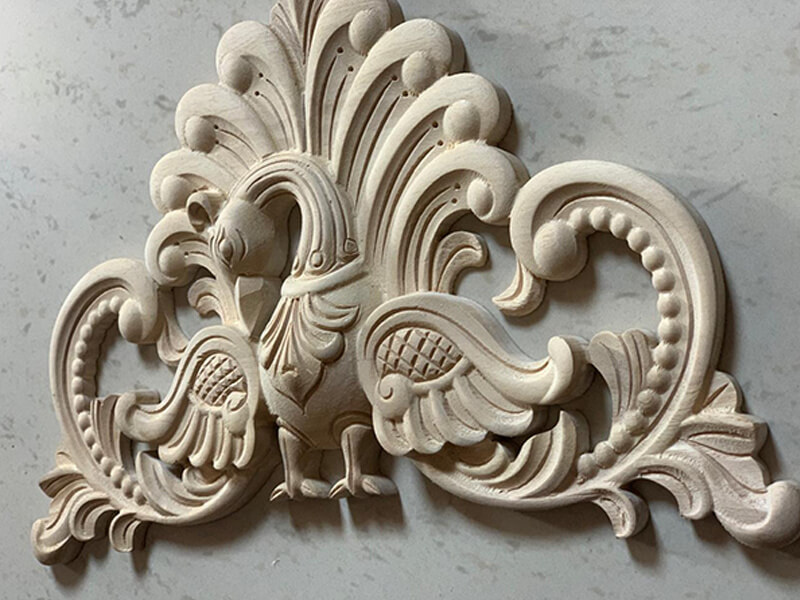
Woodworking
Cutting, carving, engraving for wood products.
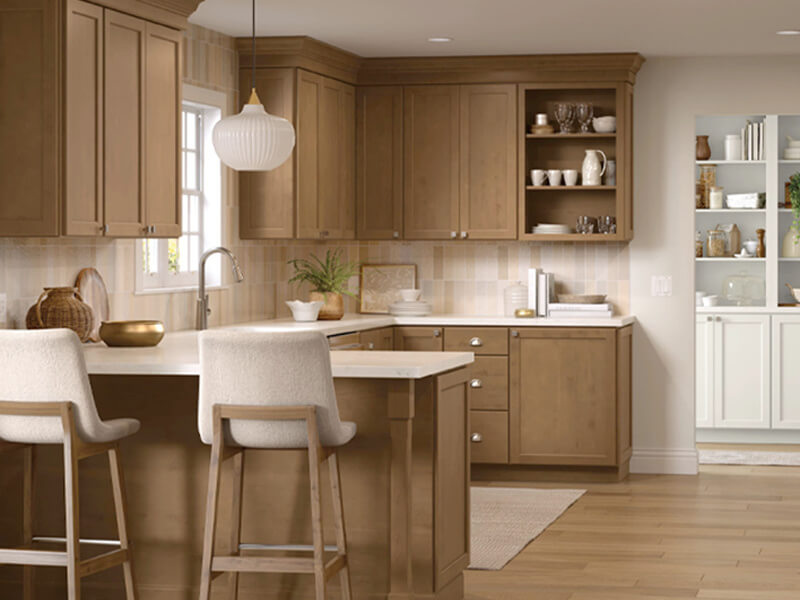
Furniture Production
Cabinetry, doors, panels and custom furniture.
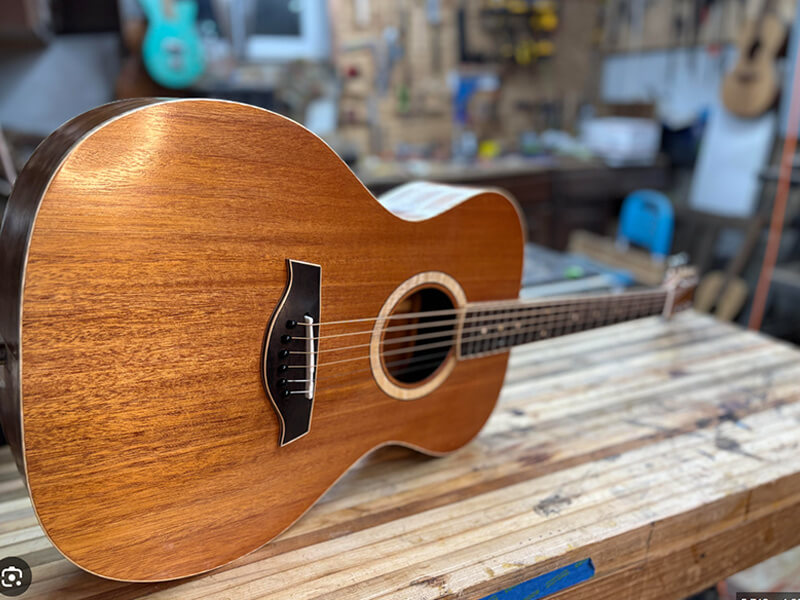
Instrument Making
3D letters, light boxes, signage and logos.
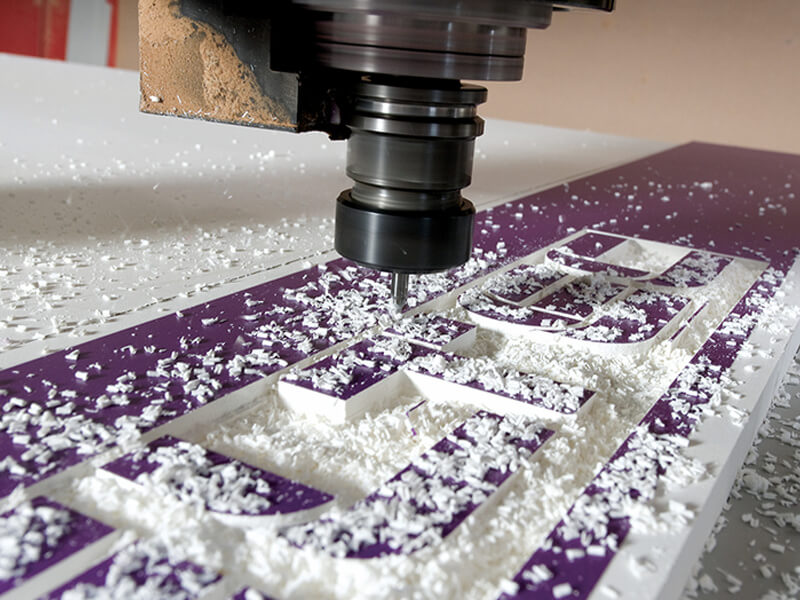
Advertising
Billboards, displays, promotion materials.

Acrylic & Plastic Processing
Cutting, engraving, polishing acrylic and plastic.

Stone Processing
Granite, marble, quartz cutting and carving.
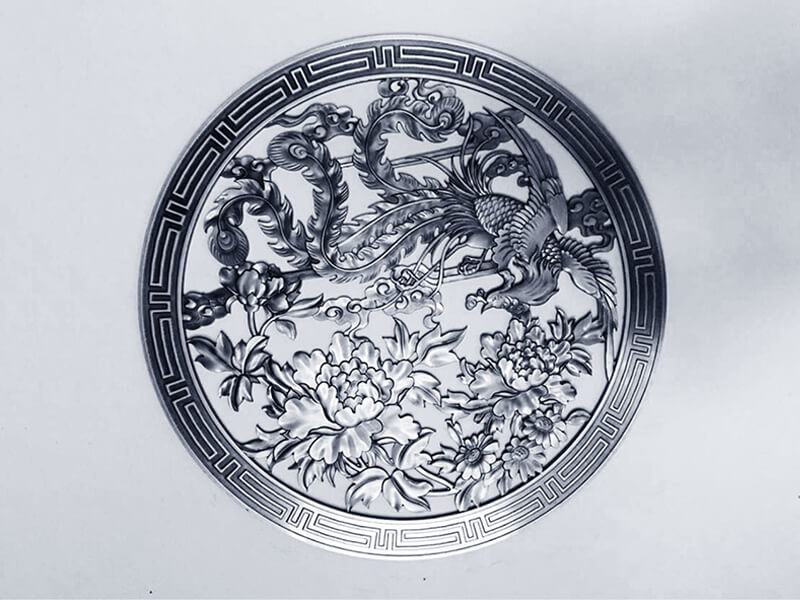
Metal Fabrication
Drilling, milling, cutting metal materials.
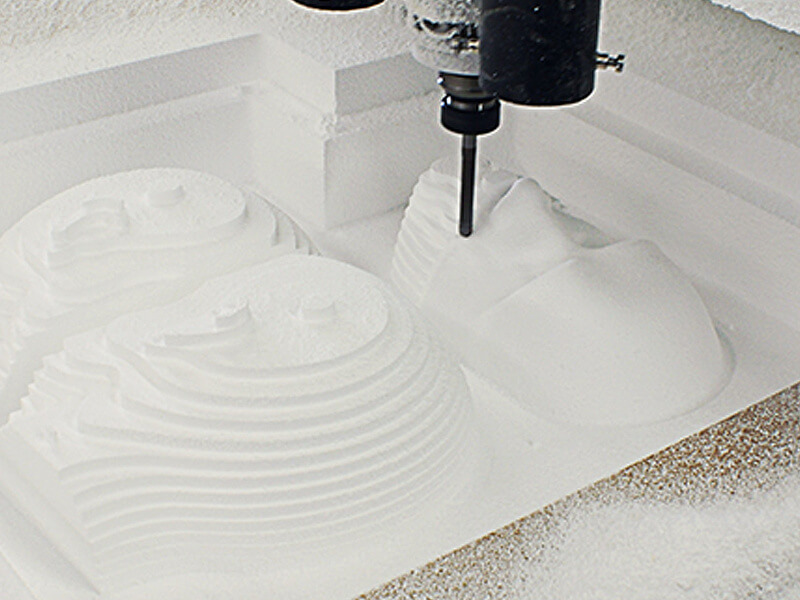
Mold & Prototype Making
Molds, prototypes and precision components.
Why should I choose a PTP CNC router instead of a standard CNC router?
Choose a PTP CNC router when your work needs flexible holding, drilling, boring, and routing on doors or furniture panels. A standard vacuum table router is good for flat sheet cutting, but a PTP table gives better access and positioning for more complex woodworking parts.
Is this machine mainly for doors or general panel processing?
It is strongest for doors, cabinets, furniture panels, and complex woodworking parts. The PTP table, HSD boring head, and carousel tool magazine make it especially useful when one part needs drilling, routing, milling, and tool changes in the same production flow.
What is the biggest advantage of the PTP table?
The biggest advantage is flexible workholding. Instead of holding the whole sheet on a flat vacuum table, the PTP table uses rails and vacuum pods. This helps hold doors, panels, and shaped parts securely while leaving more space for machining around the workpiece.
Does this machine have a boring head?
Yes. This PTP CNC router uses an Italy HSD 12V4H boring head. That makes it more suitable for furniture parts that need repeated drilling, hinge holes, connector holes, and other boring operations. This is a key difference from many basic CNC routers.
Is the 9kW HSD spindle suitable for professional woodworking?
Yes. The machine uses a 9kW Italy HSD spindle with 24,000 rpm. This gives it strong capability for routing, milling, engraving, and other woodworking operations. Combined with the boring head and tool magazine, it fits professional door and furniture panel production.
Can this machine process long door panels?
Yes. The working area is 1300 × 3000 × 200 mm, which gives more length than many standard 1325 machines. This makes it suitable for many door panels, furniture parts, and longer woodworking components. Always confirm your exact workpiece size before ordering.
What software and control system does it use?
The machine uses ALPHACAM software and a SYNTEC control system. The reference page highlights Syntec’s large storage space, U-disk compatibility, fast reading speed, automatic scheduling, and strong anti-interference capability, which are useful for multi-process furniture production.
Is this machine good for cabinet production?
Yes, especially if cabinet parts need drilling, boring, routing, and milling. If your main work is only sheet nesting, a nesting CNC router may be enough. But if your cabinet parts need flexible pod holding and multiple machining operations, this PTP CNC router is more suitable.
Can it process acrylic and signage too?
Yes. The application section includes signage, logos, badges, display boards, acrylic engraving and cutting, and other advertising materials. However, this page should keep the main focus on PTP CNC router use for doors, cabinets, and furniture panels.
What should I send before asking for a quote?
Send your product type, door or panel size, material, drilling requirements, boring hole layout, and whether you need routing, milling, or engraving. If possible, send drawings or sample photos. These details help confirm whether this PTP CNC router fits your production workflow.